MASTG-TECH-0068: Disassembling Native Code
Because Objective-C and Swift are fundamentally different, the programming language used to write the app affects the feasibility of reverse engineering it. For example, Objective-C allows method invocations to be changed at runtime. This makes hooking into other app functions (a technique heavily used by Cycript and other reverse engineering tools) easy. This "method swizzling" is implemented differently in Swift, which makes the technique harder to implement in Swift than in Objective-C.
On iOS, all the application code (both Swift and Objective-C) is compiled to machine code (e.g. ARM). Thus, to analyze iOS applications, a disassembler is needed.
If you want to disassemble an application from the App Store, remove the FairPlay DRM first. See Obtaining and Extracting Apps for more information.
In this context, the term "app binary" refers to the Mach-O file in the application bundle, which contains the compiled code and should not be confused with the application bundle - the IPA file. See Exploring the App Package for more details on the composition of IPA files.
Disassembling With IDA Pro
If you have a license for IDA Pro, you can also analyze the app binary with IDA Pro.
The free version of IDA unfortunately does not support the ARM processor type.
To get started, open the app binary in IDA Pro.
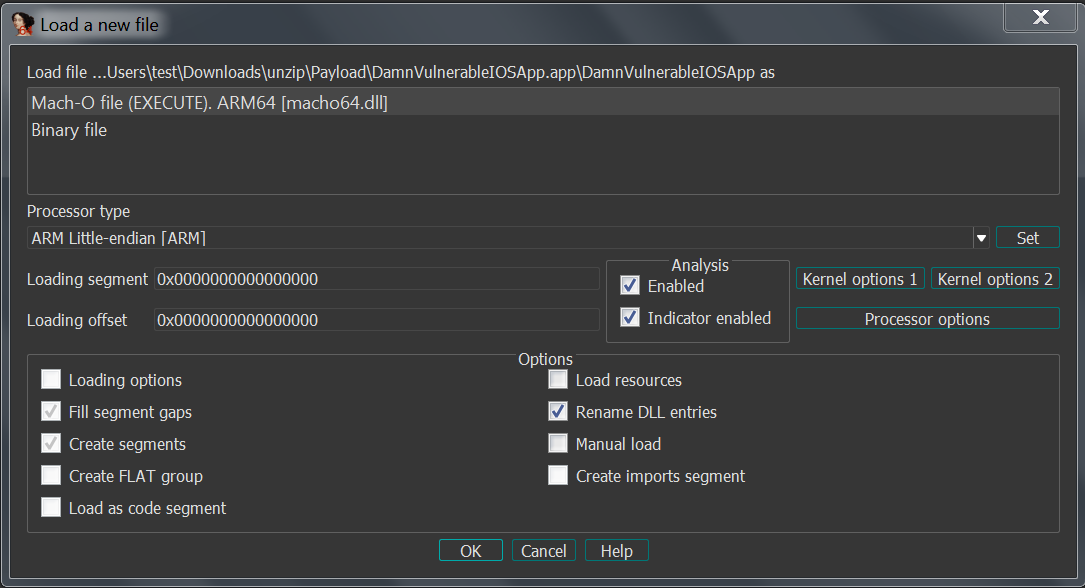
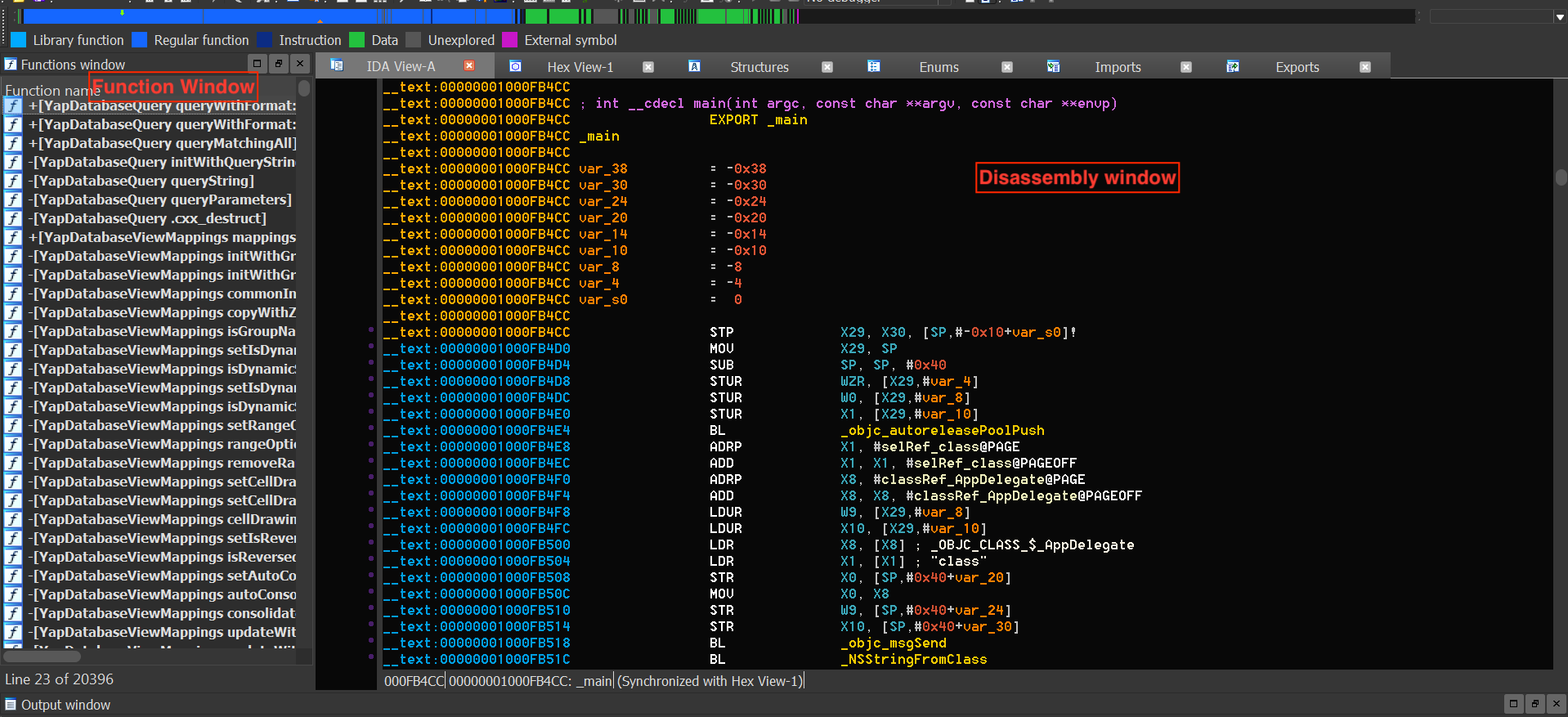
Upon opening the file, IDA Pro will perform auto-analysis, which can take some time depending on the binary's size. Once the auto-analysis is completed, you can browse the disassembly in the IDA View (Disassembly) window and explore functions in the Functions window, both shown in the screenshot below.
A regular IDA Pro license does not include a decompiler by default and requires an additional license for the Hex-Rays decompiler, which is expensive. In contrast, Ghidra consists of a highly capable, free built-in decompiler, making it a compelling alternative for reverse engineering.
If you have a regular IDA Pro license and do not want to buy the Hex-Rays decompiler, you can use Ghidra's decompiler by installing the GhIDA plugin for IDA Pro.